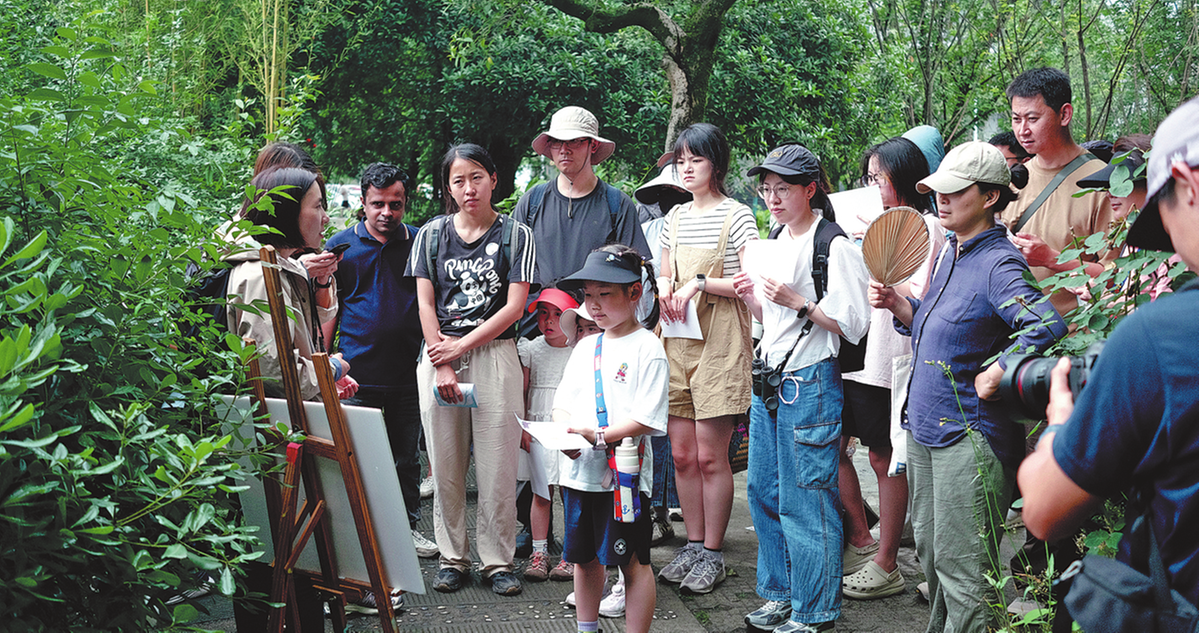
Hu Min (left) introduces the Chengdu Otter Watch project on the campus of Sichuan Agricultural University in Dujiangyan, Sichuan province, on May 23. WEN QILE/FOR CHINA DAILYMore than 100 researchers, conservationists, nature enthusiasts and members of the public gathered at the Dujiangyan campus of Sichuan Agricultural University on May 23 for the inaugural Otter Forum.
It included a seminar and two round-table discussions in the morning, tours of otter habitats on the surrounding campus in the afternoon and a full-day exhibition on otters living in urban areas.
The Eurasian otter (Lutra lutra), often referred to as the Old World otter, is a second-class protected species in China and is listed as near-threatened by the International Union for Conservation of Nature.
The forum marked the culmination of the first-ever Chengdu Otter Observation Week. Coinciding with World Otter Day on May 27, it was a weeklong celebration of public science that highlighted the importance of urban biodiversity, promoted the potential of ecotourism, and sought to aid the survival of otters.
"Sichuan Agricultural University is currently the only known university in China with a stable presence of Eurasian otters," said Hu Min, one of the founders of Follow the River, a Chengdu-based social enterprise dedicated to river ecosystem conservation. Hu's organization initiated and organized the otter observation week and the forum.
Few people in China have seen them in the wild. Hu and her colleagues were drawn to this elusive animal after discovering that the natural predators were quietly returning to Chengdu, a metropolis with over 20 million residents.
"The campus's drainage channels and artificial ponds provide space for a few otters to move, feed and rest," Hu told China Daily.
"Our Chengdu Otter Watch project team has been monitoring otters in and around the Dujiangyan campus since November 2025, observing and documenting their lives in the urban area," Hu said. "Our otter week aims to unveil the hidden lives of otters in our midst. So the campus is a perfect venue for the forum."
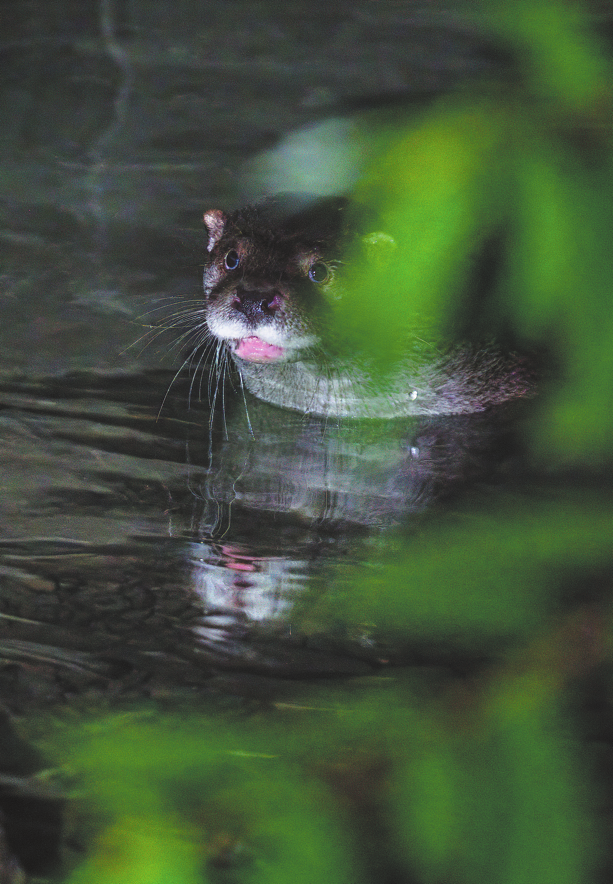 A Eurasian otter spotted in Dujiangyan. YU HUAN/FOR CHINA DAILY
Project launch
On Dec 4, 2024, a short video posted on social media showed an otter swimming near the New Century Global Center, a landmark building in downtown Chengdu, capital of Sichuan province.
The otter, which appeared briefly, sparked the curiosity of Hu and her colleague, Yu Huan. Hu, 37, who has worked on river conservation in the Chengdu Plain since 2014, was inspired by environmental advocacy during her college days and graduate studies in environmental economics and public policy.
In 2018, she founded the social enterprise with Yu, an ardent birdwatcher and nature lover, with a small goal — to reveal and rebuild the profound connection between cities and rivers, and between humans and water. "It's not easy," she said. "Urban rivers can seem dull due to decades of urbanization and management. So, when an otter swam into the city center, I was secretly thrilled. What better way to spark people's imagination about the river world than a mammal?"
Within 24 hours, over 10 local nature observers and conservationists, including Hu and Yu, began searching for the otter. They searched for several nights but found nothing — no footprints, no droppings — and produced no images.
Just as many stopped looking, another sighting occurred on Dec 31, 2024. This time, it was even more surprising. An otter was not in the water but was seen walking along a riverside greenbelt. The social media video was titled, "Does anyone know what this big rat is?"
"For me, this wasn't just a wildlife sighting. It was a moment of encounter between two mammals, otters and humans, in the city," Hu said.
At that time, Hu and Yu didn't know whether the otter was just passing through or had settled in the urban waterways. What did this mean for urban river ecology and biodiversity? They realized that the otters might bring important information, and if they didn't respond, they would miss a critical window for data collection.
So, they made a decision — "We need to respond more seriously and systematically to the otters that swam into the city center," Hu said. In 2025, the pair launched the Chengdu Otter Watch project.
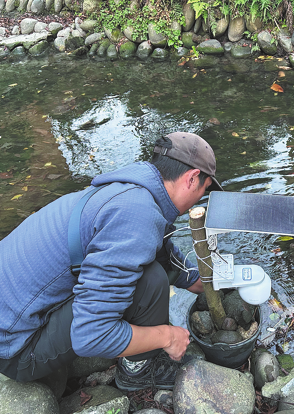 Yu Huan conducts a field survey at an otter habitat in Chengdu. HU MIN/FOR CHINA DAILY
Challenges faced
Once they decided to take the matter seriously, answering a series of practical questions took precedence.
"If otters are returning to the city, we want to know whether otters are currently residing in Chengdu's urban waterways. How do they utilize the habitat resources of Chengdu's rivers? What challenges might urban river and channel management pose to the survival and population expansion or reproduction of otters? How do Chengdu residents perceive and feel about otters?" Hu said.
They soon found that answering these questions was challenging.
At first, the otter's elusive, solitary and nocturnal habits posed significant challenges for investigation.
The complex urban context they faced proved even more difficult. Chengdu is not just a city; it is a river system. Thousands of years of interaction between nature and humans have shaped the unique water system and urban layout of the Chengdu Plain. "This is the context we face — a complex system and a species difficult to observe. We must design our strategies very cleverly, observe carefully and interpret our data prudently," Hu said.
Their project officially launched on July 1, 2025. During the conceptual phase, they made a clear decision — to make citizen science their core strategy.
They combined public reporting with scientific monitoring as their primary approach. Their initial leads came from public reports. They also noticed that there were scattered observation records on social media platforms.
"One of our most important tasks is to gather this information and encourage more citizens to become 'otter observers'," Hu said. In collaboration with the Tencent Foundation, the project established a public reporting platform. When citizens spot otters, they can submit their information through this online system, including location, time, photos, videos, behavioral descriptions and other observations.
They compiled nearly 40 public otter sighting records, all with video evidence, from 2021 to December 2025. The results surprised them. Chengdu administers 20 districts, counties and county-level cities, including Dujiangyan, and half of them had public sightings of otters during that period.
The two key monitoring river segments they selected were determined based on the preliminary public report data.
Once a sighting was identified, they conducted on-site investigations, including habitat surveys, feces and trace searches, feces collection, infrared monitoring and social surveys.
Meanwhile, volunteers recruited by the team could also participate in field investigations after training. They also established close scientific collaboration with a team from a research institution in Chengdu.
Otter feces samples collected in the field were sent to their laboratory for DNA sequencing, which would be used for subsequent analyses of the number of individual otters, population structure, kinship, genetic diversity and effective population assessment in the Chengdu area, Hu said.
Conservation questions
The project also sought to answer the question of how urban rivers could be made more otter-friendly. To address the challenge of steep, hardened riverbanks, especially during dry seasons, the team tested three low-cost otter-friendly climbing facilities. Two of these were successfully used by otters within three months, showing that small changes to urban river design could significantly benefit otters.
As the project progressed, Hu, Yu and their colleagues began to ask larger questions, such as what kind of river ecosystems and urban governance mechanisms could support healthy otter populations and their coexistence with humans.
"We realized that addressing these questions required collaboration across scales and disciplines," Hu said.
The project is becoming a model for multi-stakeholder collaboration, involving citizens, researchers, universities, government agencies, media and businesses, she said. "It demonstrates how public participation could bridge science and action, fostering a shared understanding of urban ecosystems."
Professor Zhang Lingqing, deputy dean of Sichuan Agricultural University's College of Architecture and Urban-Rural Planning, is a consultant for the otter watch project. He was impressed by his encounter with an otter at an artificial drainage channel in Dujiangyan.
"Cities, often perceived as concrete jungles, are ecosystems in their own right," he told local media.
"What might appear as 'negative spaces', like small islands and artificial channels, are in fact 'active spaces' that play a crucial role in safeguarding urban biodiversity. These areas can serve as ecological corridors for wildlife."
The return of the otters to Chengdu is more than just a conservation success story, Zhang said.
It highlights the potential for cities to support biodiversity and for citizens to play a role in environmental stewardship. "When we talk about living in harmony with nature, it shouldn't just be a grand vision. It should be a process we can observe, analyze and act upon," Hu said.
For Hu and Yu, their project is far from over. They will continue to monitor the otters, knowing that long-term data will be crucial for understanding their population size, breeding status and survival in the city.
In the long term, Hu said, they will explore greater potential for the project and make an effort to turn it into a model conservation project with public participation.
"In Chengdu, we have snow leopards in the mountains, giant pandas in the forests, and now, otters in our rivers," said Yu, who also leads a citizen science project to monitor the migration of raptors in Chengdu. "We expect that our project can not only advance scientific knowledge but also foster a deeper connection between people and their urban environment, proving that even in a metropolis of over 20 million people, there is room for wildness to thrive."