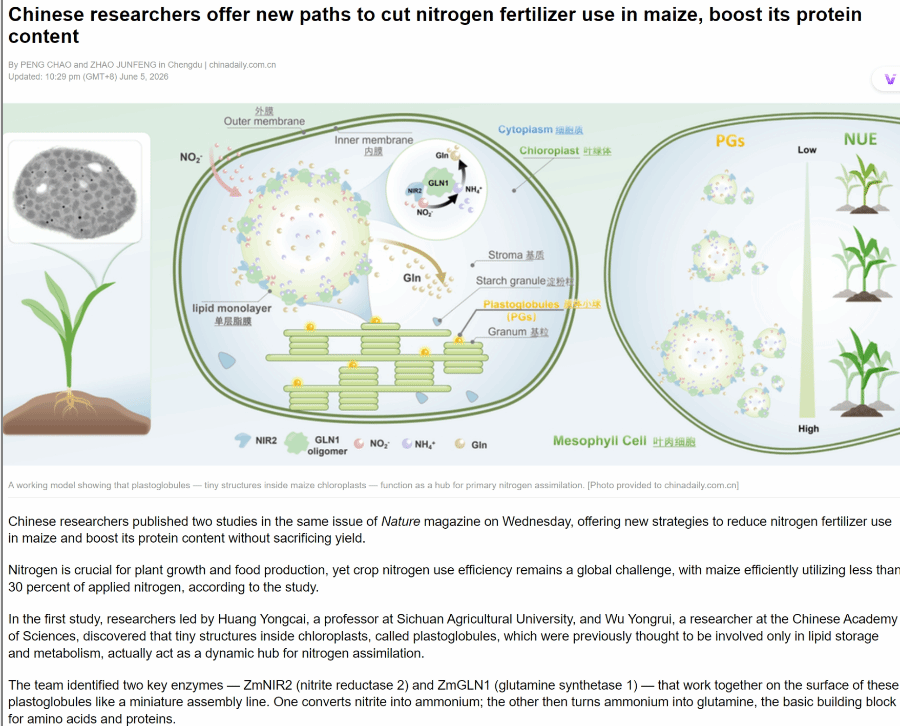
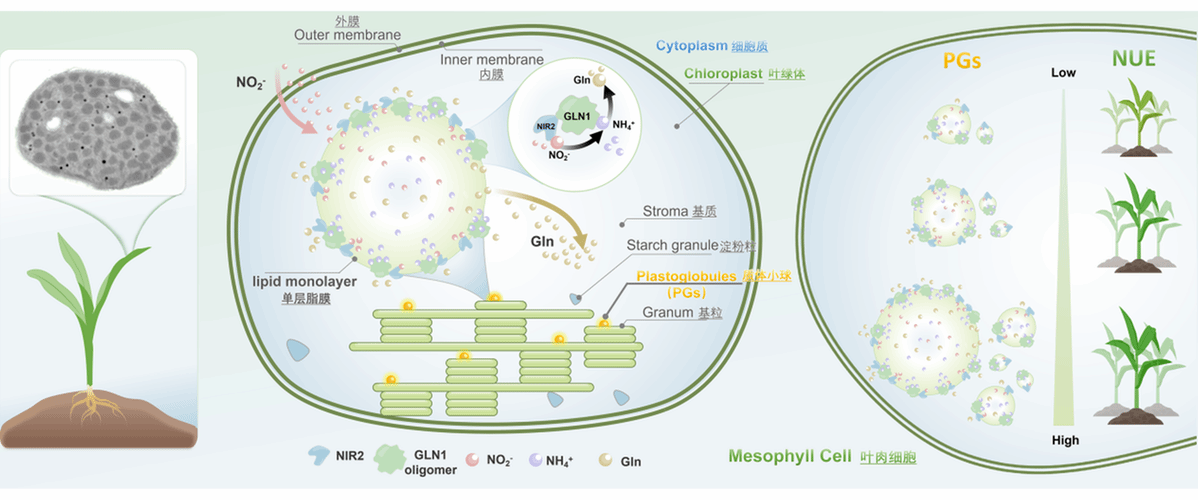
A working model showing that plastoglobules — tiny structures inside maize chloroplasts — function as a hub for primary nitrogen assimilation. [Photo provided to chinadaily.com.cn]Chinese researchers published two studies in the same issue of Nature magazine on Wednesday, offering new strategies to reduce nitrogen fertilizer use in maize and boost its protein content without sacrificing yield.
Nitrogen is crucial for plant growth and food production, yet crop nitrogen use efficiency remains a global challenge, with maize efficiently utilizing less than 30 percent of applied nitrogen, according to the study.
In the first study, researchers led by Huang Yongcai, a professor at Sichuan Agricultural University, and Wu Yongrui, a researcher at the Chinese Academy of Sciences, discovered that tiny structures inside chloroplasts, called plastoglobules, which were previously thought to be involved only in lipid storage and metabolism, actually act as a dynamic hub for nitrogen assimilation.
The team identified two key enzymes — ZmNIR2 (nitrite reductase 2) and ZmGLN1 (glutamine synthetase 1) — that work together on the surface of these plastoglobules like a miniature assembly line. One converts nitrite into ammonium; the other then turns ammonium into glutamine, the basic building block for amino acids and proteins.
This coordination allows them to orchestrate sub-organellar nitrogen assimilation and dictate nitrogen use efficiency in maize, the study said.
Importantly, this mechanism is not unique to maize. The same process may also occur in other major crops such as rice, wheat, soybean and sorghum. This means scientists could build on these findings to develop nitrogen-efficient crop varieties, researchers said.
The second study, with Huang Yongcai as the first author, addresses maize's naturally low protein content. By studying teosinte, the wild ancestor of maize, which can contain up to 30 percent protein, the team cloned a high-protein gene, THP3-T. It encodes a nitrogen-metabolism enzyme that is far more active than the variant present in modern maize.
Field trials show that THP3-T alone raises kernel protein from about 10 percent to over 13 percent without reducing yield. When combined with THP9-T, another high-protein gene previously identified by Huang, the two genes produce synergistic effects. Introduced into China's most widely planted hybrid maize variety, they lifted kernel protein from 8.5 percent to between 12 and 13 percent, with no impact on yield, according to the study.
The researchers have already used these two genes to upgrade more than 80 parental lines of major Chinese maize varieties, with protein levels reaching up to 14 percent.
A 4-percentage-point increase in the protein content of China's feed maize would generate extra protein equivalent to over 30 million metric tons of soybeans, roughly 30 percent of the country's annual soybean imports, researchers said.